Alternatives to 4/4 patterns...

jandara

New member
Jun 11, 2005
44
0
1
I developped ear fatigue with 4/4 snare drum patterns lately.

nagl.gif
Been listening to a lot of Gil Scott Heron, Last Poets, Laurindo Almeida instead.I am looking for groovy tracks with no obvious 4/4 snare drum or rim shot patterns, tracks where piano riffs, percussions, voices or whatever are used to create syncopation. Afro, Latin Jazz, Calypso, Bossa stylee.Drop knowledge on me!
 
I developped ear fatigue with 4/4 snare drum patterns lately.
nagl.gif


Been listening to a lot of Gil Scott Heron, Last Poets, Laurindo Almeida instead.
I am looking for groovy tracks with no obvious 4/4 snare drum or rim shot patterns, tracks where piano riffs, percussions, voices or whatever are used to create syncopation. Afro, Latin Jazz, Calypso, Bossa stylee.
Drop knowledge!

do you mean grooves where the snares aren't necessarily on two and four? saying "4/4" is a bit misleading. i would bet that all the music you named is in a 4/4 time signature.
 
If your talking about in production terms, try keeping your kick/snare on the 4 and throw in a tom/hat loop in 5/4. Mine are a bunch of recordings i took of a drummer freind one saturday. It keeps the structure easy enough to work with, but is fresh on the ears.
 
Just abandon conventional notions of time and make up your own time signatures - 33/7 and a bit, 1/1.1, 15/0, completely random, etc. If people say it sounds like crap, just tell them it's an acquired taste.
 
I am talking about records that do not use a typical bass & snare drum (2-4 or 1-3...) to create a rhythm regardless of time signature or do away with the snare completly, ie Gil Scott Heron - Who Will Pay Reparation On My Soul, Willie Bobo - Roots, Mongo Santamaria - Afro Blue....
Any suggestions?
 
Just abandon conventional notions of time and make up your own time signatures - 33/7 and a bit, 1/1.1, 15/0, completely random, etc. If people say it sounds like crap, just tell them it's an acquired taste.
hahahha!
 
Just abandon conventional notions of time and make up your own time signatures - 33/7 and a bit, 1/1.1, 15/0, completely random, etc. If people say it sounds like crap, just tell them it's an acquired taste.
so you're saying, just play free jazz?
 
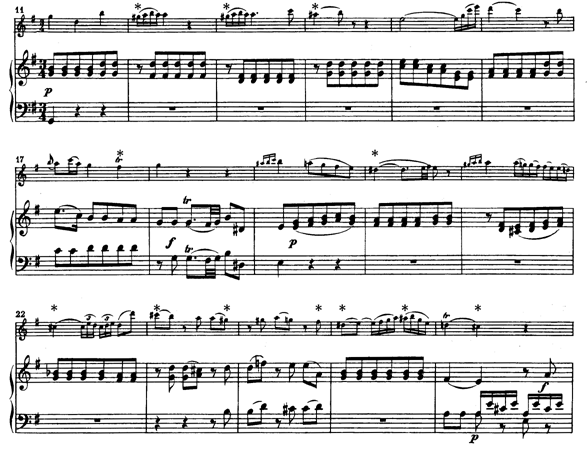
it would be interesting how the 4/4 pattern came about in the first place.

Mozart-1.gif


NO LONGER WILL I CONFORM TO THIS.
 
Just abandon conventional notions of time and make up your own time signatures - 33/7 and a bit, 1/1.1, 15/0, completely random, etc. If people say it sounds like crap, just tell them it's an acquired taste.
hell yes tonality and rhythm are PLEAYED OUT. eskimo raps over 'music for 18 musicians' and shit.
 
Very basically, the 4/4, syncopated (accents on the 2+4) rhythm is a very (western) African time signature. All European music (folk songs, shanties etc ??? not classical.) were in 3/4 time, up until the introduction of the influence of African music, through slaves.
But it was really the meeting of the two, in the very beginnings of what would become jazz, that formed the 4/4 beat we know now. The enforced structure of European time, and the Syncopation of African rhythm.


As for music that isn???t your basic 4/4. Try African, Brazillian music. Or I would personally recommend anything that falls inbetween Jay Dee and Brokenbeat. There???s tons of it out there, listen to Benji B on 1xtra.
 
Also I know Dj Shaddow was very much on a non-linier tip when creating his last lp.
 
Very basically, the 4/4, syncopated (accents on the 2+4) rhythm is a very (western) African time signature. All European music (folk songs, shanties etc ??? not classical.) were in 3/4 time, up until the introduction of the influence of African music, through slaves.
But it was really the meeting of the two, in the very beginnings of what would become jazz, that formed the 4/4 beat we know now. The enforced structure of European time, and the Syncopation of African rhythm.
From where'd you hear that?
 
Very basically, the 4/4, syncopated (accents on the 2+4) rhythm is a very (western) African time signature. All European music (folk songs, shanties etc ??? not classical.) were in 3/4 time, up until the introduction of the influence of African music, through slaves.
But it was really the meeting of the two, in the very beginnings of what would become jazz, that formed the 4/4 beat we know now. The enforced structure of European time, and the Syncopation of African rhythm.
From where'd you hear that?
Which bit? Am I wrong?
 
The introduction of 4/4 time because of African slaves sounds really suspect.

The popular syncopation on two and four is correct, though. And its African origin.
 
Don Ellis was a fanboy for doing different time signatures.
I like the track "Strawberry Soup".
 
Just abandon conventional notions of time and make up your own time signatures - 33/7 and a bit, 1/1.1, 15/0, completely random, etc. If people say it sounds like crap, just tell them it's an acquired taste.
classic.

really you can superimpose any time signature against 4/4. a really good resource for this is a book called "The Art of Bop Drumming" by john riley... it's really good and easy to see different ways of breaking things up and learning to accent beats to make the simple 2 and 4 sound different.. and if you have a drum kit, it goes over lots of other things that a drummer should know..

good luck,
rob
 
The introduction of 4/4 time because of African slaves sounds really suspect.

The popular syncopation on two and four is correct, though. And its African origin.
That doesn't mean to say that Africans didn't use the 4/4 rhythm pattern before this. But they used may differing forms of rhythm without a rigidly defined structure. Europeans loved thier structure.

Africans were bought over as slaves, and therefore introduced to European music. As a result of which, they began to create new versions of African music and rhythm, that had influences from European music. That could not have existed without this coming together (of sorts). For example the cakewalk.

Cakewalk, led to ragtime, led to populisation and appropriation of 'black' music. And the western world's love affair with 4/4 time is born.

This is all from a very western centric point of view mind.
 
Whoa. That's not even close to what happened.

4/4 time relative to European music predates African slavery by at least a couple of centuries.

And the influence of African slaves on European music -- a music informed by Christianity and composed by those contracted by royalty -- seems very, very absurd.

I mean, if the "cakewalk" is your point of reference, you're off by half a millennium.
 
Yeah I'm pretty sure duple meter was used quite heavily in european music way before slavery. The argument that more syncopation was introduced by slaves might hold up, but certainly not 4/4 time signature.
 
Whoa. That's not even close to what happened.

4/4 time relative to European music predates African slavery by at least a couple of centuries.

And the influence of African slaves on European music -- a music informed by Christianity and composed by those contracted by royalty -- seems very, very absurd.

I mean, if the "cakewalk" is your point of reference, you're off by half a millennium.
Fisrt off, this thread was about jazz. So I was trying, with my admittedly limited knowledge, to describe how syncopated form of 4/4 time in jazz came about. Not how 4/4 time in general came into existance.

Second, there is plenty of European folk music, that has been around since before christianity, that has nothing to do with royalty. Absurd I know.

If you know so much about this, why not say your piece, instead of just attacking what I say.