
What!? No Ferguson Talk on Here!!?
- Thread starter RAJ
- Start date
You are using an out of date browser. It may not display this or other websites correctly.
You should upgrade or use an alternative browser.
You should upgrade or use an alternative browser.



And now the cops have killed a COPS crew member in a hail of bullet because the police clearly have no clue what they are doing and just mow everything down with lead. Can we take their guns away now?
By Marah Eakin @marahe
Aug 27, 2014 4:23 PM
A crew member working on an episode of Cops was shot and killed last night. Sound engineer Bryce Dion, 38, was in Omaha, Nebraska, following police who were engaged in a shootout with a robbery suspect at a WendyÔÇÖs. Officials said about 30 shots were firedÔÇöall of them by the police. Meanwhile, the robbery suspect, identified as Cortez Washington, was armed only with a pellet gun.
All Cops crew members wear bulletproof vests during filming, but Dion was hit ÔÇ£under his left arm,ÔÇØ according to authorities, with the bullet slipping into the opening between the vest and his body as he held up the microphone during taping. No one else from the crew or police force was injured.
In a statement, Langley Productions, the company behind Cops, said itÔÇÖs ÔÇ£deeply saddened and shocked by this tragedy,ÔÇØ calling Dion ÔÇ£a long term member of the Cops team and a very talented and dedicated person.ÔÇØ
By Marah Eakin @marahe
Aug 27, 2014 4:23 PM
A crew member working on an episode of Cops was shot and killed last night. Sound engineer Bryce Dion, 38, was in Omaha, Nebraska, following police who were engaged in a shootout with a robbery suspect at a WendyÔÇÖs. Officials said about 30 shots were firedÔÇöall of them by the police. Meanwhile, the robbery suspect, identified as Cortez Washington, was armed only with a pellet gun.
All Cops crew members wear bulletproof vests during filming, but Dion was hit ÔÇ£under his left arm,ÔÇØ according to authorities, with the bullet slipping into the opening between the vest and his body as he held up the microphone during taping. No one else from the crew or police force was injured.
In a statement, Langley Productions, the company behind Cops, said itÔÇÖs ÔÇ£deeply saddened and shocked by this tragedy,ÔÇØ calling Dion ÔÇ£a long term member of the Cops team and a very talented and dedicated person.ÔÇØ

Fred_Garvin said:
The inherent nature of the human beings behind the problem does not alter or excuse the nature of the problem.
Sorry for the super delayed response.
Fred, I do appreciate your time and thank you for the clarification but it does not change my initial reaction or how evil it sounds when it is looked at through a different lens or circumstance. My precise intention was to take it out of context and point out the collectivist and bigoted nature of judging people based on arbitrary features as well as factors of choice. I believe the overall tone of this thread has largely been ÔÇØfuck the policeÔÇØ has it not? I sympathize with the consensus to have more oversight in tax payer funded police departments there just arenÔÇÖt easy solutions.
I am well aware of the many different philosophical and socio-economic levels and opinions about collectivism as well as the undeniable evils of racism. When people support collectivism and place individuals in boxes the word ÔÇ£allÔÇØ is often assumed that is why I used the example of (all) rich people, poor people, black people, white people etc. It is no coincidence that some people who support collectivist ideas also seem to be idealistic egalitarians.
I think it is wicked to make generalizations about people and I definitely do not believe in any type of inherent human ÔÇ£natureÔÇØ. I also know there is and never will be any level of equality because as individuals we all have many different strengths and weakness. I feel the same way about egalitarians as I do about collectivists and believe it is a problem within the culture accompanied by poor philosophy. In my view that is the real nature of the problem, not economics, politics or social systems. I could be mistaken but I think this is where we maybe disagree and that was exactly what I was speaking to.
I am interested in hearing from anyone on their perspective of this question:
In the event that charges are brought against the officer involved, how will prosecutors in this case
provide proof that it was a racially motivated murder?
The inherent nature of the human beings behind the problem does not alter or excuse the nature of the problem.
Sorry for the super delayed response.
Fred, I do appreciate your time and thank you for the clarification but it does not change my initial reaction or how evil it sounds when it is looked at through a different lens or circumstance. My precise intention was to take it out of context and point out the collectivist and bigoted nature of judging people based on arbitrary features as well as factors of choice. I believe the overall tone of this thread has largely been ÔÇØfuck the policeÔÇØ has it not? I sympathize with the consensus to have more oversight in tax payer funded police departments there just arenÔÇÖt easy solutions.
I am well aware of the many different philosophical and socio-economic levels and opinions about collectivism as well as the undeniable evils of racism. When people support collectivism and place individuals in boxes the word ÔÇ£allÔÇØ is often assumed that is why I used the example of (all) rich people, poor people, black people, white people etc. It is no coincidence that some people who support collectivist ideas also seem to be idealistic egalitarians.
I think it is wicked to make generalizations about people and I definitely do not believe in any type of inherent human ÔÇ£natureÔÇØ. I also know there is and never will be any level of equality because as individuals we all have many different strengths and weakness. I feel the same way about egalitarians as I do about collectivists and believe it is a problem within the culture accompanied by poor philosophy. In my view that is the real nature of the problem, not economics, politics or social systems. I could be mistaken but I think this is where we maybe disagree and that was exactly what I was speaking to.
I am interested in hearing from anyone on their perspective of this question:
In the event that charges are brought against the officer involved, how will prosecutors in this case
provide proof that it was a racially motivated murder?


JustAlice said:Fred_Garvin said:
The inherent nature of the human beings behind the problem does not alter or excuse the nature of the problem.
Sorry for the super delayed response.
Fred, I do appreciate your time and thank you for the clarification but it does not change my initial reaction or how evil it sounds when it is looked at through a different lens or circumstance. My precise intention was to take it out of context and point out the collectivist and bigoted nature of judging people based on arbitrary features as well as factors of choice. I believe the overall tone of this thread has largely been ÔÇØfuck the policeÔÇØ has it not? I sympathize with the consensus to have more oversight in tax payer funded police departments there just arenÔÇÖt easy solutions.
I am well aware of the many different philosophical and socio-economic levels and opinions about collectivism as well as the undeniable evils of racism. When people support collectivism and place individuals in boxes the word ÔÇ£allÔÇØ is often assumed that is why I used the example of (all) rich people, poor people, black people, white people etc. It is no coincidence that some people who support collectivist ideas also seem to be idealistic egalitarians.
I think it is wicked to make generalizations about people and I definitely do not believe in any type of inherent human ÔÇ£natureÔÇØ. I also know there is and never will be any level of equality because as individuals we all have many different strengths and weakness. I feel the same way about egalitarians as I do about collectivists and believe it is a problem within the culture accompanied by poor philosophy. In my view that is the real nature of the problem, not economics, politics or social systems. I could be mistaken but I think this is where we maybe disagree and that was exactly what I was speaking to.
I am interested in hearing from anyone on their perspective of this question:
In the event that charges are brought against the officer involved, how will prosecutors in this case
provide proof that it was a racially motivated murder?
The Police culture is fueled by collectivism.
My pops was a cop and he told me its all about stereotypes.
Soldiers arent supposed to think. And arent trained to.
They act upon established and reinforced generalizations.
The inherent nature of the human beings behind the problem does not alter or excuse the nature of the problem.
Sorry for the super delayed response.
Fred, I do appreciate your time and thank you for the clarification but it does not change my initial reaction or how evil it sounds when it is looked at through a different lens or circumstance. My precise intention was to take it out of context and point out the collectivist and bigoted nature of judging people based on arbitrary features as well as factors of choice. I believe the overall tone of this thread has largely been ÔÇØfuck the policeÔÇØ has it not? I sympathize with the consensus to have more oversight in tax payer funded police departments there just arenÔÇÖt easy solutions.
I am well aware of the many different philosophical and socio-economic levels and opinions about collectivism as well as the undeniable evils of racism. When people support collectivism and place individuals in boxes the word ÔÇ£allÔÇØ is often assumed that is why I used the example of (all) rich people, poor people, black people, white people etc. It is no coincidence that some people who support collectivist ideas also seem to be idealistic egalitarians.
I think it is wicked to make generalizations about people and I definitely do not believe in any type of inherent human ÔÇ£natureÔÇØ. I also know there is and never will be any level of equality because as individuals we all have many different strengths and weakness. I feel the same way about egalitarians as I do about collectivists and believe it is a problem within the culture accompanied by poor philosophy. In my view that is the real nature of the problem, not economics, politics or social systems. I could be mistaken but I think this is where we maybe disagree and that was exactly what I was speaking to.
I am interested in hearing from anyone on their perspective of this question:
In the event that charges are brought against the officer involved, how will prosecutors in this case
provide proof that it was a racially motivated murder?
The Police culture is fueled by collectivism.
My pops was a cop and he told me its all about stereotypes.
Soldiers arent supposed to think. And arent trained to.
They act upon established and reinforced generalizations.

vintageinfants said:
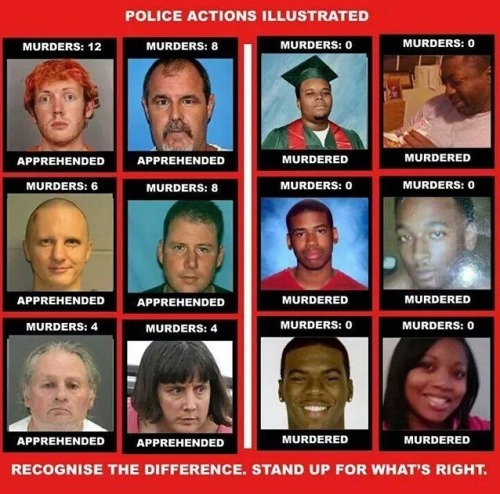
Hey,
I'm sure the strong pull of 'belief in a just world' will grant someone the creativity to explain how race-ethnicity has no bearing on the above image.
Peace,
Big Stacks from Kakalak
Hey,
I'm sure the strong pull of 'belief in a just world' will grant someone the creativity to explain how race-ethnicity has no bearing on the above image.
Peace,
Big Stacks from Kakalak

I guess everyone has seen this.
The point is when an unarmed teen is gunned down we should be outraged.
But some people appear to be outraged not by the homicide, but by the resulting outrage.
Some are even manufacturing excuses for the shooter.
[media]//www.youtube.com/embed/eUi2A6tUYQk[/media]
The point is when an unarmed teen is gunned down we should be outraged.
But some people appear to be outraged not by the homicide, but by the resulting outrage.
Some are even manufacturing excuses for the shooter.
[media]//www.youtube.com/embed/eUi2A6tUYQk[/media]
Pennsylvania Judge Sentenced For 28 Years For Selling Kids to the Prison System
Mark Ciavarella Jr, a 61-year old former judge in Pennsylvania, has been sentenced to nearly 30 years in prison for literally selling young juveniles for cash. He was convicted of accepting money in exchange for incarcerating thousands of adults and children into a prison facility owned by a developer who was paying him under the table. The kickbacks amounted to more than $1 million.
The Pennsylvania Supreme Court has overturned some 4,000 convictions issued by him between 2003 and 2008, claiming he violated the constitutional rights of the juveniles ÔÇô including the right to legal counsel and the right to intelligently enter a plea. Some of the juveniles he sentenced were as young as 10-years old.
Ciavarella was convicted of 12 counts, including racketeering, money laundering, mail fraud and tax evasion. He was also ordered to repay $1.2 million in restitution.
His ÔÇ£kids for cashÔÇØ program has revealed that corruption is indeed within the prison system, mostly driven by the growth in private prisons seeking profits by any means necessary.
ÔÇö-
Why might this not be a HUGE national story and his name not household? IÔÇÖll give you one guess what color those kids were.
Big_Stacks said:vintageinfants said:
Hey,
I'm sure the strong pull of 'belief in a just world' will grant someone the creativity to explain how race-ethnicity has no bearing on the above image.
Peace,
Big Stacks from Kakalak
It definitely isn't just without any context.
Hey,
I'm sure the strong pull of 'belief in a just world' will grant someone the creativity to explain how race-ethnicity has no bearing on the above image.
Peace,
Big Stacks from Kakalak
It definitely isn't just without any context.

JustAlice said:Fred_Garvin said:
The inherent nature of the human beings behind the problem does not alter or excuse the nature of the problem.
I think it is wicked to make generalizations about people and I definitely do not believe in any type of inherent human ÔÇ£natureÔÇØ.
http://en.wikipedia.org/wiki/Stanford_prison_experiment
The inherent nature of the human beings behind the problem does not alter or excuse the nature of the problem.
I think it is wicked to make generalizations about people and I definitely do not believe in any type of inherent human ÔÇ£natureÔÇØ.
http://en.wikipedia.org/wiki/Stanford_prison_experiment
JustAlice said:Big_Stacks said:vintageinfants said:
Hey,
I'm sure the strong pull of 'belief in a just world' will grant someone the creativity to explain how race-ethnicity has no bearing on the above image.
Peace,
Big Stacks from Kakalak
It definitely isn't just without any context.
Hey,
I don't think such stark evidence needs context. It speaks for itself. In related news, I just found out the waitress I mentioned earlier in this thread doesn't want to serve me anymore. Psychic defenses are very strong.
Peace,
Big Stacks from Kakalak
Hey,
I'm sure the strong pull of 'belief in a just world' will grant someone the creativity to explain how race-ethnicity has no bearing on the above image.
Peace,
Big Stacks from Kakalak
It definitely isn't just without any context.
Hey,
I don't think such stark evidence needs context. It speaks for itself. In related news, I just found out the waitress I mentioned earlier in this thread doesn't want to serve me anymore. Psychic defenses are very strong.
Peace,
Big Stacks from Kakalak
JustAlice said:Fred, I do appreciate your time and thank you for the clarification but it does not change my initial reaction or how evil it sounds when it is looked at through a different lens or circumstance. My precise intention was to take it out of context and point out the collectivist and bigoted nature of judging people based on arbitrary features as well as factors of choice. I believe the overall tone of this thread has largely been ÔÇØfuck the policeÔÇØ has it not? I sympathize with the consensus to have more oversight in tax payer funded police departments there just arenÔÇÖt easy solutions.
I am well aware of the many different philosophical and socio-economic levels and opinions about collectivism as well as the undeniable evils of racism. When people support collectivism and place individuals in boxes the word ÔÇ£allÔÇØ is often assumed that is why I used the example of (all) rich people, poor people, black people, white people etc. It is no coincidence that some people who support collectivist ideas also seem to be idealistic egalitarians.
I think it is wicked to make generalizations about people and I definitely do not believe in any type of inherent human ÔÇ£natureÔÇØ. I also know there is and never will be any level of equality because as individuals we all have many different strengths and weakness. I feel the same way about egalitarians as I do about collectivists and believe it is a problem within the culture accompanied by poor philosophy. In my view that is the real nature of the problem, not economics, politics or social systems. I could be mistaken but I think this is where we maybe disagree and that was exactly what I was speaking to.
I am interested in hearing from anyone on their perspective of this question:
In the event that charges are brought against the officer involved, how will prosecutors in this case
provide proof that it was a racially motivated murder?
OK, fair enough. A few things:
Why? Without context, anything can mean anything. When you take it out of context, you ignore the meaning... and when you say "well, look how terrible it sounds if I apply this statement to a different group", it doesn't work, because the groups you're referring to are not equal to each other, for a variety of reasons.
This is not judgment, it is a discussion about real things that have actually happened, not arbitrary features or choices. We're not just randomly choosing to speculate that police have unjustly killed people (among other things) with little or no accountability in doing so. There is documented history of this happening, repeatedly, and I referenced this in my earlier post as well.
I wouldn't say so... out of ten pages, there have been a relatively small number of comments with anything resembling this tone. I have read the general sentiment of this thread as 'The Ferguson incident was terrible and wrong, and this behavior is not uncommon, and what will it take for something to be done about it?'
I'm curious to know how you simply read 'fuck the police' when most of the discussion has been considerably more nuanced than that?
Except nobody's doing that. You have now implied more than once that we're all saying "all police are bad", and that's not the case. And again, police departments are, by both their design and their practice, highly collectivist, which you don't seem to acknowledge or take issue with when you criticize collectivism. I think you are using an extremely narrow (and possibly inaccurate) definition of what collectivism means.
So far, it appears that you think it's wicked to do it regarding police. I've seen no indication that you care whether it's done to anyone else. The Ferguson PD seems to have made a pretty serious generalization about Mike Brown (and he's only one of many for whom this has happened). Would you agree?
OK, but that goes against the findings of pretty much everyone who's seriously studied human behavior, going all the way back to Aristotle. Humans, like all animals, have distinguishing common behavioral characteristics. There is much debate over what those actually mean, but that's a different topic. I assume you meant nature in a moral sense, and I probably shouldn't have used the term 'inherent nature' in the post you quoted... something like 'general behavior pattern' might have been more accurate. I think I used it in response to the "not all cops are bad" perspective you've shown... but again, it wasn't quite accurate. However, as I stated earlier, that's not the point. Unwarranted killing is still a serious matter. Pretending it was OK is even more serious. Even acknowledging it and saying "I made a mistake" doesn't cut it. If your mistakes kill people, you may need to be in a different line of work.
Egalitarianism is not about individual strengths and weaknesses. You're thinking of the story of Harrison Bergeron. That's fiction.
I disagree that what you've said here contains any sort of clarity. I've clearly stated the nature and details of my perspective on the problem we're discussing. Here, you've taken the words "the problem" and surrounded them with philosophical and sociological vagaries. In your view, what problem are we discussing? Because honestly, I'm getting the sense that we're not even talking about the same thing.
Should they have to? Murder is a violation of law, isn't that enough? How about just proving that an officer unjustly killed a person, and a kid at that? The important thing to note, in terms of racial motivation, is that Michael Brown's life was worth the same as a white man's, and anyone who truly believes that wouldn't be concerned that a racial element was necessary for the charge to be valid. It would not likely be included in a charge, i.e. a murder charge would be termed "murder", not "racial murder".
Other than the general (and not unreasonable) community sentiment that there was racial motivation, why do you think that's something a prosecutor should have to prove? If there was no racial motivation, does that make it OK?
I am well aware of the many different philosophical and socio-economic levels and opinions about collectivism as well as the undeniable evils of racism. When people support collectivism and place individuals in boxes the word ÔÇ£allÔÇØ is often assumed that is why I used the example of (all) rich people, poor people, black people, white people etc. It is no coincidence that some people who support collectivist ideas also seem to be idealistic egalitarians.
I think it is wicked to make generalizations about people and I definitely do not believe in any type of inherent human ÔÇ£natureÔÇØ. I also know there is and never will be any level of equality because as individuals we all have many different strengths and weakness. I feel the same way about egalitarians as I do about collectivists and believe it is a problem within the culture accompanied by poor philosophy. In my view that is the real nature of the problem, not economics, politics or social systems. I could be mistaken but I think this is where we maybe disagree and that was exactly what I was speaking to.
I am interested in hearing from anyone on their perspective of this question:
In the event that charges are brought against the officer involved, how will prosecutors in this case
provide proof that it was a racially motivated murder?
OK, fair enough. A few things:
My precise intention was to take it out of context
Why? Without context, anything can mean anything. When you take it out of context, you ignore the meaning... and when you say "well, look how terrible it sounds if I apply this statement to a different group", it doesn't work, because the groups you're referring to are not equal to each other, for a variety of reasons.
collectivist and bigoted nature of judging people based on arbitrary features as well as factors of choice
This is not judgment, it is a discussion about real things that have actually happened, not arbitrary features or choices. We're not just randomly choosing to speculate that police have unjustly killed people (among other things) with little or no accountability in doing so. There is documented history of this happening, repeatedly, and I referenced this in my earlier post as well.
I believe the overall tone of this thread has largely been ÔÇØfuck the policeÔÇØ has it not?
I wouldn't say so... out of ten pages, there have been a relatively small number of comments with anything resembling this tone. I have read the general sentiment of this thread as 'The Ferguson incident was terrible and wrong, and this behavior is not uncommon, and what will it take for something to be done about it?'
I'm curious to know how you simply read 'fuck the police' when most of the discussion has been considerably more nuanced than that?
When people support collectivism and place individuals in boxes the word ÔÇ£allÔÇØ
Except nobody's doing that. You have now implied more than once that we're all saying "all police are bad", and that's not the case. And again, police departments are, by both their design and their practice, highly collectivist, which you don't seem to acknowledge or take issue with when you criticize collectivism. I think you are using an extremely narrow (and possibly inaccurate) definition of what collectivism means.
I think it is wicked to make generalizations about people
So far, it appears that you think it's wicked to do it regarding police. I've seen no indication that you care whether it's done to anyone else. The Ferguson PD seems to have made a pretty serious generalization about Mike Brown (and he's only one of many for whom this has happened). Would you agree?
I definitely do not believe in any type of inherent human ÔÇ£natureÔÇØ
OK, but that goes against the findings of pretty much everyone who's seriously studied human behavior, going all the way back to Aristotle. Humans, like all animals, have distinguishing common behavioral characteristics. There is much debate over what those actually mean, but that's a different topic. I assume you meant nature in a moral sense, and I probably shouldn't have used the term 'inherent nature' in the post you quoted... something like 'general behavior pattern' might have been more accurate. I think I used it in response to the "not all cops are bad" perspective you've shown... but again, it wasn't quite accurate. However, as I stated earlier, that's not the point. Unwarranted killing is still a serious matter. Pretending it was OK is even more serious. Even acknowledging it and saying "I made a mistake" doesn't cut it. If your mistakes kill people, you may need to be in a different line of work.
I also know there is and never will be any level of equality because as individuals we all have many different strengths and weakness
Egalitarianism is not about individual strengths and weaknesses. You're thinking of the story of Harrison Bergeron. That's fiction.
I feel the same way about egalitarians as I do about collectivists and believe it is a problem within the culture accompanied by poor philosophy. In my view that is the real nature of the problem, not economics, politics or social systems. I could be mistaken but I think this is where we maybe disagree and that was exactly what I was speaking to.
I disagree that what you've said here contains any sort of clarity. I've clearly stated the nature and details of my perspective on the problem we're discussing. Here, you've taken the words "the problem" and surrounded them with philosophical and sociological vagaries. In your view, what problem are we discussing? Because honestly, I'm getting the sense that we're not even talking about the same thing.
In the event that charges are brought against the officer involved, how will prosecutors in this case provide proof that it was a racially motivated murder?
Should they have to? Murder is a violation of law, isn't that enough? How about just proving that an officer unjustly killed a person, and a kid at that? The important thing to note, in terms of racial motivation, is that Michael Brown's life was worth the same as a white man's, and anyone who truly believes that wouldn't be concerned that a racial element was necessary for the charge to be valid. It would not likely be included in a charge, i.e. a murder charge would be termed "murder", not "racial murder".
Other than the general (and not unreasonable) community sentiment that there was racial motivation, why do you think that's something a prosecutor should have to prove? If there was no racial motivation, does that make it OK?

LaserWolf said:^ what does that mean?
the argument to "remove context" sustained massive damage.
the argument to "remove context" sustained massive damage.
Fred_Garvin said:It would not likely be included in a charge, i.e. a murder charge would be termed "murder", not "racial murder".
You finally hit on something I would totally agree with except that isnÔÇÖt what the ÔÇ£reasonable community sentimentÔÇØ is saying at all. I guess my biggest question for you guys is how would you define justice? Why the consensus that there WAS racial motivation if it shouldn't or doesn't matter?
I didnÔÇÖt say racial motivation was something the prosecutor would have to prove I asked how he would prove it. I also didnÔÇÖt say anything about the validity of any charge. Murder is murder and I completely agree. ÔÇ£Police Officer Shoots TeenagerÔÇØ is a vastly different headline than ÔÇ£White Police Officer Shoots Black TeenagerÔÇØ Is it a matter of individual rights or civil rights?
You canÔÇÖt go on and on about racial motivation for 10 pages and suddenly say murder is murder.
That is disingenuous and subjective as fuck.
I am asking how does one prove that and what that means as far as a sense of justice is concerned. You can over analyze and pick apart everything I said and twist it however you want but I just want to have a conversation about what is right not a pissing match about who is right.
You finally hit on something I would totally agree with except that isnÔÇÖt what the ÔÇ£reasonable community sentimentÔÇØ is saying at all. I guess my biggest question for you guys is how would you define justice? Why the consensus that there WAS racial motivation if it shouldn't or doesn't matter?
I didnÔÇÖt say racial motivation was something the prosecutor would have to prove I asked how he would prove it. I also didnÔÇÖt say anything about the validity of any charge. Murder is murder and I completely agree. ÔÇ£Police Officer Shoots TeenagerÔÇØ is a vastly different headline than ÔÇ£White Police Officer Shoots Black TeenagerÔÇØ Is it a matter of individual rights or civil rights?
You canÔÇÖt go on and on about racial motivation for 10 pages and suddenly say murder is murder.
That is disingenuous and subjective as fuck.
I am asking how does one prove that and what that means as far as a sense of justice is concerned. You can over analyze and pick apart everything I said and twist it however you want but I just want to have a conversation about what is right not a pissing match about who is right.
"ÔÇ£Police Officer Shoots TeenagerÔÇØ is a vastly different headline than ÔÇ£White Police Officer Shoots Black TeenagerÔÇØ Is it a matter of individual rights or civil rights?"
The difference is, one contains more factual content than the other.
Taken out of context we have a homicide.
In context we have the culmination of years of civil rights abuses.
Ferguson population


To talk about the shooting of Michael Brown and not talk about race ignores the context in which the shooting occurred.
As for criminal prosecution. You are right. The Ferguson Police Department will almost certainly be found guilty of civil rights violations. Michael Brown's killer may also be found guilty of civil rights violations. The chances of Michael Brown's killer being found guilty of homicide is next to zero. If you go back and read this thread, I think you will see that, the lack of prosecution of police is one of the reasons for anger toward the police.
The Justice Department has been using statistics like these to bring civil rights cases against police departments across the country. Including Portland.
http://en.wikipedia.org/wiki/U.S._v._City_of_Portland
http://www.oregonlive.com/today/index.ssf/2014/09/ferguson_shooting_justice_dept.html
The difference is, one contains more factual content than the other.
Taken out of context we have a homicide.
In context we have the culmination of years of civil rights abuses.
Ferguson population
To talk about the shooting of Michael Brown and not talk about race ignores the context in which the shooting occurred.
As for criminal prosecution. You are right. The Ferguson Police Department will almost certainly be found guilty of civil rights violations. Michael Brown's killer may also be found guilty of civil rights violations. The chances of Michael Brown's killer being found guilty of homicide is next to zero. If you go back and read this thread, I think you will see that, the lack of prosecution of police is one of the reasons for anger toward the police.
The Justice Department has been using statistics like these to bring civil rights cases against police departments across the country. Including Portland.
http://en.wikipedia.org/wiki/U.S._v._City_of_Portland
http://www.oregonlive.com/today/index.ssf/2014/09/ferguson_shooting_justice_dept.html
Fred_Garvin said: Why the consensus that there WAS racial motivation if it shouldn't or doesn't matter?
Collectivism
Similar threads

- Replies
- 6
- Views
- 5K


- Replies
- 18
- Views
- 2K
- Replies
- 2
- Views
- 315

- Replies
- 17
- Views
- 2K